A high-throughput screening (HTS) was developed to identify WRN inhibitor (WRNi) molecules.
This HTS uses 1536-wellplate and amenable to variations in WRNi molecule dose-dependent and time-dependent experimental studies.
Background
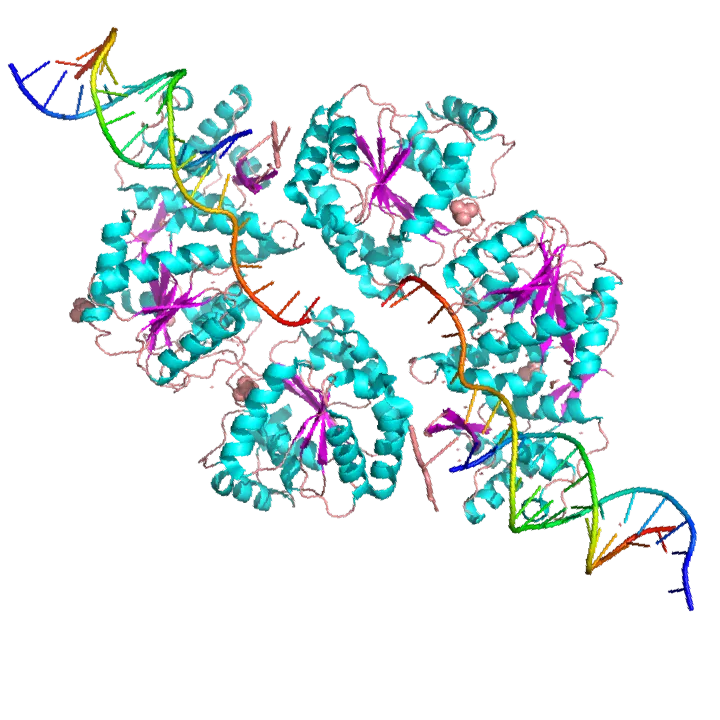
The complete Werner Syndrome protein (WRN) is an enzyme that consists of a helicase, ATPase and exonuclease activities. The helicase enzyme functions as part of a DNA repair mechanism translocating along the strand to unwind the double helix in a 3’ to 5’ directional movement while also consuming ATP. The WRN protein is part of the RecQ family.
This validation qHTS assay is related to Werner’s Syndrome Protein as part of the five distinct RecQ helicase homologs. WRN which is important in resolving abnormal DNA structures formed during replication or homologous recombination.
Recently, WRN was found to exist as a synthetic lethal target in cancers with defective DNA mismatch repair pathways resulting in genomic microsatellite instability. These specific cancer types are known as high microsatellite instability (MSI-H) cancers.
The characteristics of being MSI-H presents a therapeutic opportunity to design and synthesize molecules specific to target MSI-H cancer, since WRN inhibition is tolerated in microsatellite stable (MSS) i.e. normal, healthy cells. Therefore, MSI-H presents as druggable feature of selective cellular inhibition.
Cellular division and coinciding maintenance of genomic integrity relies on detecting and repairing DNA damage. On the other hand, cancer treatment relies on chemotherapeutics that kill cancer cells through extensive DNA damage. The application of anticancer chemotherapeutics are not completely effective as resistance to therapy may occur by increasing DNA repair functions.
Remarkably, some cancer cell lines, but not normal cells, exhibit reduced growth and an increase in cell death upon WRN inhibition.
Therefore, there is interest in WRN inhibitors to target DNA helicases in numerous cancers that play a key role in chemoresistance pathways.
WRN HTS format was first published in 2019 by Sommers et al.1
The assay is based on quantitative HTS (qHTS) of Bloom’s Syndrome Helicase (BLM) assay. Another helicase enzyme in the same human RecQ family responsible for maintaining the genome.
Mechanism of Action
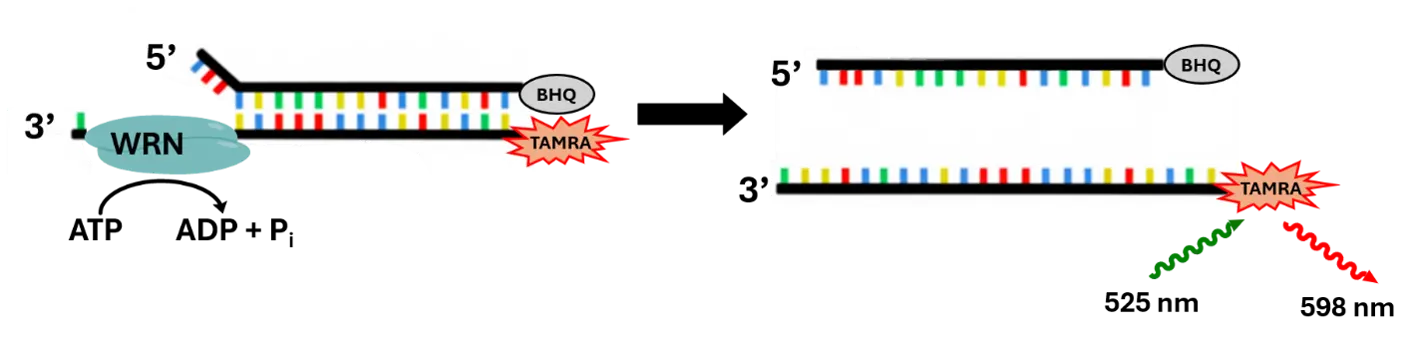
The validation assay was a fluorescence quenching based kinetic qHTS for WRN Helicase DNA unwinding.
The activity was measured as ATP-dependent separation of a 10-bp with 8-nucleotide (nt) single-stranded tails or 20-bp DNA duplex extended by 30-nt single-stranded tails, as forked duplexes.
The forked DNA duplexes or substrates are tagged with either a BHQ-2 (Black Hole Quencher 2) dark quencher on the 3’-end or rhodamine fluorophore (carboxytetramethyl rhodamine, TAMRA) on the 5’-end. The end group location of the tails can either be 3' or 5' as long as the TAMRA and BHQ-2 moieties are in proximity to each other i.e. on the same end of the oligoDNA duplex.
The initial oligoDNAs are covalently bound by hydrogen bonding as a duplex. Addition of WRN and ATP results in strand separation thereby increasing TAMRA’s fluorescence (excitation 525 nm, emission 598 nm) as the fluorophore escapes from BHQ quencher.
Therefore, TAMRA absorbs in the visible green wavelength and emits excitation in the red-shifted region
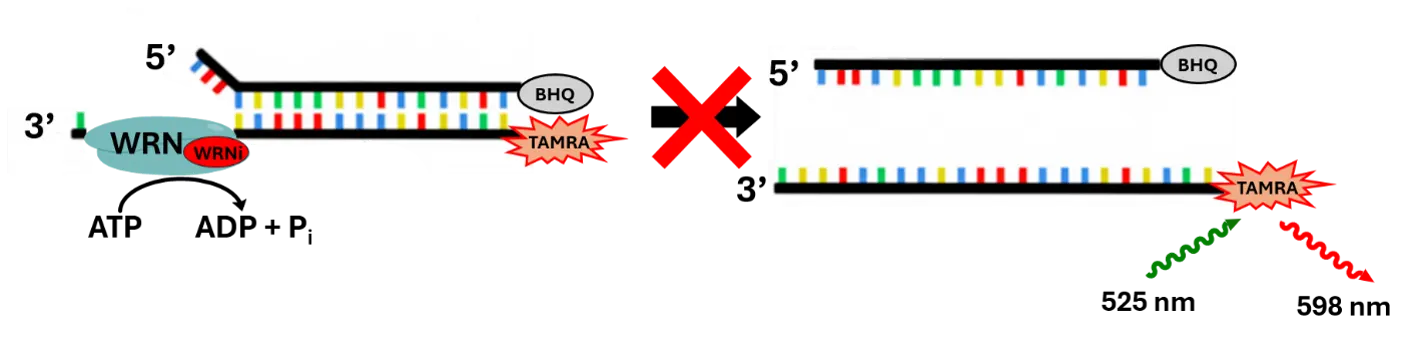
Fig 1. Fluorometric helicase assay development. (A) Illustration of fluorometrically labeled forked DNA consisting of TAMRA and quenched by adjacent BHQ-labeled complementary strand. WRN utilizes ATP to unwind the duplex DNA. (B) WRNi binds to WRN helicase which inhibit dsDNA unwinding.
Materials and Reagents
Liquid Handler equipped with 1536-pin tool
Black Optical transparent flat-bottom 1536 well plates
Various pipettes (1 uL – 1000 uL)
Heat block
Plate reader equipped with fluorescent filters
1.5 or 2 mL centrifuge tubes
Molecules of interest as potential WRNi
Oligo-DNA (oligo-BHQ and oligo-TAMRA)
Optional: non-specific WRN helicase inhibitor (used as a positive control)
Tris-HCl (pH 8.0)
NaCl
MgCl2
DTT
Tween- 20
2-deoxyinosinic-deoxycytidylic acid sodium salt [poly(dI-dC)]
BSA
DMSO, ACS grade or better
production of catalytically active recombinant WRN helicase protein
Recommend to use a purified a functional GST-tagged WRN helicase domain (amino acids 500–946). This WRN500-946 helicase would be scalable for higher production at higher concentrations in comparison to full length WRN protein
DNA oligos: oligo-(50-bp or 18-bp)BHQ2 and Oligo-(50-bp or 18-bp)TAMRA
Refer to the protocol below for the nucleotide sequence
Example Protocol: Time-dependent assay (with optional concentration-dependence)
To develop a high-throughput fluorescent assay for assessing helicase activity, the following example protocol may be used as a template for further optimization to reaction conditions, and concentrations of reagents in a low-volume assay format.
Synthesize desired oligoDNA strand sequence corresponding to Oligo-BHQ2 and Oligo-TAMRA
In a centrifuge tube, weigh oligo-BHQ2 and Oligo-TAMRA in 1.2:1 molar ratios, respectively
Dissolve in 50 mM NaCl and 1× TE buffer (10 mM Tris pH 8.0, 1 mM EDTA)
Reaction Buffer Solution Prep: 3 uL of reaction buffer (25 mM Tris-HCl (pH 8.0), 5 mM NaCl, 2 mM MgCl2, 1mM DTT, 0.01% Tween- 20, and 2.5 ug/ml [deoxyinosinic-deoxycytidylic acid sodium salt] poly(dI-dC)2
OligoDNA (oligonucleotides) Prep: Example oligoDNA 50-bp1
OligoDNA (oligonucleotides) Prep: Example oligoDNA 18-bp 3
Oligo-BHQ2: 5'-TGTGTGTGGTTCGCTGGG-(BHQ2)-3'
Oligo-TAMRA: 5'-(TAMRA)-CCCAGCGAAACTGGTGTGTGT-3'
Cap the centrifuge tube(s) and place in heat block and heat at 95 °C for 5 minutes
Turn off the heat block and let the oligoDNA solution slowly cool to room temperature overnight to let the oligos hybridize
High-throughput screening assay
The small molecule of interest (compounds) and controls were separately transferred to 1536-wellplates via pintool equipped with a 1536-pin array, 3 µL of GST-WRN500-946 (20 nM final concentration) or reaction buffer only were dispensed using a solenoid-valve nanoliter dispenser into a black 1536-well plate. Control (23 nl each in column 2 as dose-response) were transferred via a liquid handler pintool equipped with a 1536-pin array.
Controls included: Enzyme-free and vehicle (DMSO) for signal normalization
Plates were incubated at room temperature for 15 min,
Initiate the reactions via the addition of 1 µL of DNA duplex (100 nM DNA oligo-/oligo- substrate) and 2 mM ATP final concentrations
Plates were transferred to a plate reader whereby fluorescence was measured in kinetic mode using an excitation filter of 525 nm and emission filter of 598 nm.
Set measurement read times to desired intervals for x total minutes. Typical average reaction time achieves maximum fluorescence or yield at approximately 30 minutes.
The reaction time is substrate specific and may be optimized
Optional: Use a nonspecific helicase inhibitor (e.g. NSC 617145 (Tocris, no. 5340)) as a control to represent complete WRN enzyme inhibition.3
Data Calculations
Use Z' factor, a measure for assay quality control can be calculated using the following formula: Z' = 1-(3σS++3σS-)/|μS+-μS-|
Where 3σS+ represents 3 standard deviations from the average of positive signals
3σS- represents 3 standard deviations from the average of negative signals
μS+ and μS- represent the average of positive signals
μS- represent negative signals.
Perform signal normalization of the data by using enzyme-free group as negative controls (0% baseline) and DMSO-only treated group as the positive control (100% inhibition)
Expected results
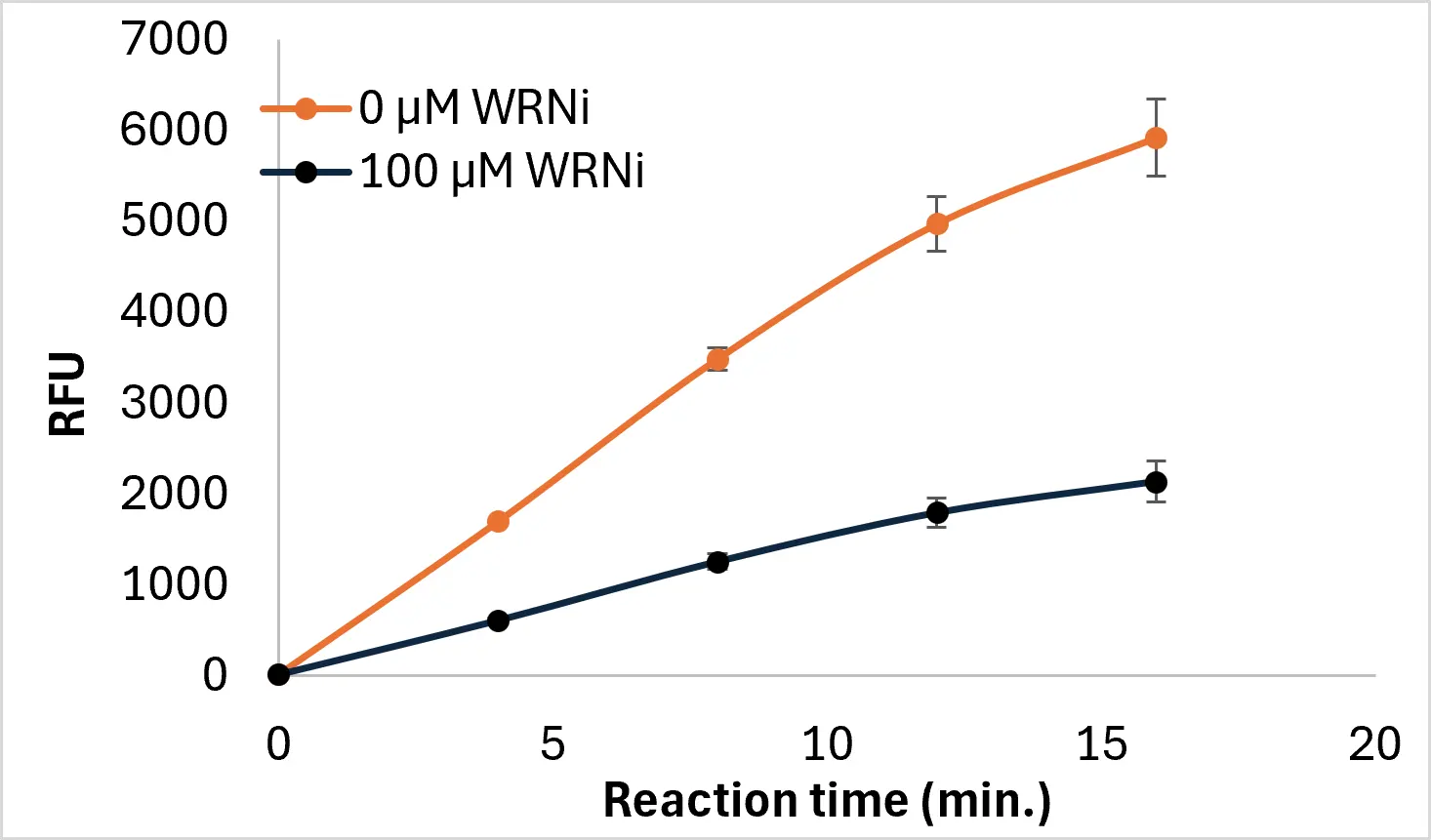
Fig 2. Real-time DNA unwinding progress curves with WRN helicase domain, oligoDNA duplex, ATP, and with or without WRNi molecule.
Commentary
Special Considerations
Addition of BSA can be added to the reaction buffer to stabilize the WRN helicase enzyme
Alternative working buffer solution has been reported as:
Criteria
Expected Value
Detection Method
Quantitative data
Precision
N/A
Sensitivity
N/A
Selectivity
N/A
Auxiliary Criteria
Estimated Value
Speed
Fast
Ease and convenience
Medium
Operator skill
Medium
Cost
Low
Selectivity
Medium
Advantages
With the existing instruments on-hand, the cost and time is significantly low.
The data is quantitative and therefore amenable to comparison for definite identification of a possible lead (hit) molecule
Limitations
Nonspecific DNA binding may occur which results in false positive data
Solution: If the molecule is known, this may be mitigated by in silico screening molecules known to be DNA binders i.e. DNA intercalators and alkylators. Exclude these fluorogenic molecules from WRN screening.
Molecules that are inherently fluorescent by themselves may result in false positive data
Solution: Screen known molecules or functional groups containing fluorophore moieties. Exclude these fluorogenic molecules from WRN screening.
WRN inhibition does not completely translate to cancer cell inhibition in vitro nor in vivo biological context. Further validation requires determining the WRNi’s capability to inhibit cancer cell viability by, for example, comparing IC50 values between different WRNi molecules.
Critical Steps: What to Look For, What to Expect (Visually)
The speed of the reaction has been reported to be relatively fast. Previous reports illustrate that the increasing fluorescence plateau after 10 minutes and quickly reaches maximum thershold.
Applications
Interpreting the data: Previous publications cited screening hit molecules i.e. effective WRNi fell three standard deviations outside the average. These hits were investigated further for potential anticancer activity4
Commercial Products
As of date, there is no commercially available kit for qHTS of WRNi
References
Sommers, J. A.; Kulikowicz, T.; Croteau, D. L.; Dexheimer, T.; Dorjsuren, D.; Jadhav, A.; Maloney, D. J.; Simeonov, A.; Bohr, V. A.; Brosh, R. M., Jr. A high-throughput screen to identify novel small molecule inhibitors of the Werner Syndrome Helicase-Nuclease (WRN). PLOS ONE 2019, 14 (1), e0210525.
qHTS Assay for Inhibitors of RecQ-Like Dna Helicase 1 (RECQ1). National Center for Biotechnology Information, 2026. https://pubchem.ncbi.nlm.nih.gov/bioassay/2549 (accessed June 13, 2026).
Kikuchi, S.; Green, J. C.; Rogness, D. C.; Lam, B.; Owyang, Z. A.; Malmstrom, R. D.; Tabatabaei, A.; Snead, A. N.; Hoffman, M. A.; Bernard, S. M.; et al. Identification of VVD-214/RO7589831, a ClinicalStage, Covalent Allosteric Inhibitor of WRN Helicase for the Treatment of MSI-High Cancers. J. Med. Chem. 2025, 68 (24), 25912-25938.
Parker, M. J.; Lee, H.; Yao, S.; Irwin, S.; Hwang, S.; Belanger, K.; de Mare, S. W.; Surgenor, R.; Yan, L.; Gee, P.; et al. Identification of 2-Sulfonyl/Sulfonamide Pyrimidines as Covalent Inhibitors of WRN Using a Multiplexed High-Throughput Screening Assay. Biochemistry 2023, 62 (14), 2147-2160.