August 25, 2026 - The U.S. Food and Drug Administration (FDA) has approved Imaavy® (nipocalimab-aahu), a recombinant human immunoglobulin G1 lambda (IgG1λ) monoclonal antibody for warm autoimmune hemolytic anemia (wAIHA).1
The drug, developed by Johnson & Johnson (Janssen Biotech), has received its first approval in April 2025 for the treatment of generalized myasthenia gravis (gMG), and now its second indication for wAIHA. As a result, Imaavy has FDA Fast Track, Priority Review and Orphan Drug designations as the first FDA-approved treatment for wAIHA.
Background: wAIHA
Warm Autoimmune Hemolytic Anemia (wAIHA) is the most common form of autoimmune hemolytic anemia (AIHA), accounting for 60–70% of all AIHA cases.2 The disease is defined by:
- IgG autoantibodies (± C3d) bound to RBCs, detected by a positive direct antiglobulin test (DAT / Coombs test) with monospecific anti-IgG antisera.
- Thermal amplitude: the autoantibodies react optimally at body temperature (37°C), hence “warm.”
- Extravascular hemolysis predominates, occurring in the spleen and liver via Fcγ receptor–mediated phagocytosis by macrophages.
Incidence is about 1 to 3 per 100,000 person-years globally; point prevalence is estimated at approximately 1 in 8,000 individuals living with the disease. The median age at onset is 52 years, with a slight female predominance. wAIHA can occur at any age and its causes are classified as either primary idiopathic or secondary to various conditions.
The disease causes premature destruction of red blood cells (hemolysis) mediated by autoantibodies active at body temperature (“warm”). The detailed pathogenic sequence in wAIHA involves2,3
- Production of polyclonal IgG autoantibodies directed against RBC surface antigens (most commonly Rh system epitopes).
- Opsonization: IgG coats the RBC surface at 37°C.
- Extravascular hemolysis: Fcγ receptors (FcγRI, FcγRIIA, FcγRIIIA) on splenic and hepatic macrophages recognize the Fc portion of bound IgG, then phagocytosis and destruction of RBC fragments in the reticuloendothelial system.
- Complement involvement (in up to ~50% of cases, DAT IgG+C3d+): weak classical pathway activation by IgG (especially IgG2/IgG4) contributes to more severe anemia and treatment refractoriness.
- Bone marrow compensation: reticulocytosis is expected but may be inadequate in >1/3 of patients, contributing to the severity of anemia.
The result is anemia, fatigue, and increased risk of morbidity and mortality due to complications such as thrombosis and infection.
Mechanism and Structure
Immunoglobulin G (IgG) is the predominant antibody class in human serum, comprising four subclasses in the order of decreasing amounts: IgG1, IgG3, IgG2, and IgG4.4 In wAIHA, pathogenic autoantibodies are predominantly of the IgG isotype (DAT positive for IgG, sometimes with C3d), which bind red blood cell (RBC) surface antigens at body temperature (37°C). These IgG-coated RBCs are then recognized by Fcγ receptors on macrophages and other reticuloendothelial cells, leading to extravascular hemolysis primarily in the spleen. The chronic inflammatory state of wAIHA has FcRn expression upregulated by pro-inflammatory cytokines (e.g., TNF-α, IL-6), further enhancing IgG recycling and sustaining elevated levels of pathogenic autoantibodies.
Imaavy is designed as an immunoselective neonatal Fc receptor (FcRn) blocker for reducing circulating pathogenic IgG autoantibodies while preserving critical immune functions. While Imaavy is an IgG1 monoclonal antibody, its therapeutic action in treating wAIHA does not come from antigen binding, as it does not target a disease-specific antigen on RBCs.5,6 Instead, Imaavy exploits the shared Fc region to competitively inhibit the neonatal Fc receptor (FcRn) by directly binding (Figure 1). Because FcRn is responsible for the recycling of IgG, blocking FcRn-mediated recycling of all circulating IgG shifts the balance from recycling to lysosomal degradation, thereby reducing total serum IgG — that is, increasing the clearance of circulating IgG, including pathogenic anti-RBC autoantibodies implicated in wAIHA — without broadly suppressing B-cell or T-cell immune function.
This reduction in circulating IgG levels occurs rapidly and is dose-dependent, with a sustained but reversible effect on serum IgG levels; for example, the median steady-state predose minimum reduction is 33% to 53% depending on the regimen. Therefore, Imaavy’s advantage is its immunoselective nature: it lowers pathogenic IgG autoantibodies while largely preserving protective immune functions. Anti-tetanus and anti-herpes zoster IgG responses are maintained, while IgA, IgM, and IgE levels are not substantially affected. The IgG reduction is rapid, dose-dependent, sustained during treatment, and reversible after discontinuation.
Figure 1. Crystal structure of nipocalimab Fab (antigen-binding) fragment (left) bound to FcRn (right). The binding epitope is in the α chain of FcRn. The light chain complementarity–determining region 1 (CDR1) overlaps to the β2M subunit N-terminal residues (PDB 9M16).5
The Fc region is aglycosylated: the absence of the N-linked glycan at Asn297 in the Fc domain eliminates binding to Fcγ receptors (FcγR) on effector cells, thereby abolishing effector functions such as antibody-dependent cellular cytotoxicity (ADCC), complement-dependent cytotoxicity (CDC), and opsonization. This is key to preventing Imaavy from triggering immune-mediated destruction of cells; it acts purely as a competitive FcRn blocker by competing with IgG for FcRn binding.
Clinical Trials
Phase 2 and 3 (ENERGY Study). The pivotal evidence for Imaavy in wAIHA comes from the ENERGY study, a phase 2/3 randomized, double-blind, placebo-controlled trial conducted across 68 sites in 18 countries.7 Before Imaavy, no therapy was FDA-approved specifically for wAIHA. Existing treatments (corticosteroids, rituximab, splenectomy, cytotoxic immunosuppressants) were used off-label or based on consensus, with significant limitations: delayed onset, high relapse rates, cumulative toxicity, and a lack of well-designed placebo-controlled trials. The ENERGY study was the first registrational, randomized, placebo-controlled trial to evaluate FcRn blockade in wAIHA — and thus the first registration-phase placebo-controlled trial to demonstrate the safety and efficacy of FcRn blockade in wAIHA.
Primary Endpoint
The primary endpoint was durable hemoglobin response, defined as a hemoglobin level ≥10 g/dL with a ≥2 g/dL increase from baseline at 3 consecutive visits spanning ≥28 days starting by Week 16, without the need for rescue therapy (IV/oral corticosteroids, transfusion, or IVIg).
Results
- Efficacy: The primary endpoint was achieved by 23.7% of patients in the Imaavy 30 mg/kg IV q4w group versus 7.7% in the placebo group (1-sided P = 0.015), indicating a statistically significant improvement over placebo.
- Secondary Endpoints:
- Fatigue: Mean change from baseline in FACIT-Fatigue score at Week 24 was significantly higher for Imaavy than for placebo (nominal P = 0.007, vs. 30 mg/kg IV q4w).
- Steroid Sparing: Among patients receiving corticosteroids, there was a significant reduction in the average daily prednisone dose (15.1% reduction with Imaavy 30 mg/kg IV q4w vs. placebo; nominal P = 0.039).
- Onset of Action: Hemoglobin increases were observed as early as Week 1, with responders showing rapid improvements.
Safety Profile
The safety profile of Imaavy was consistent with its known safety profile in other indications and with wAIHA-associated risks. The most common adverse reactions (≥10%) included peripheral edema, diarrhea, fever, fatigue, headache, dizziness, asthenia, pyrexia, and COVID-19. Serious adverse events (SAEs) were lower in the treatment groups compared to placebo (21.1% vs. 35.9%).
Formulation
Imaavy is supplied as a single-dose vial containing either 300 mg/1.62 mL or 1,200 mg/6.5 mL of nipocalimab-aahu at a concentration of 185 mg/mL.8 The drug itself is a fully human IgG1 monoclonal antibody with an aglycosylated Fc region, which lacks effector functions (e.g., complement activation or binding to Fc receptors on immune cells) (Figure 2).
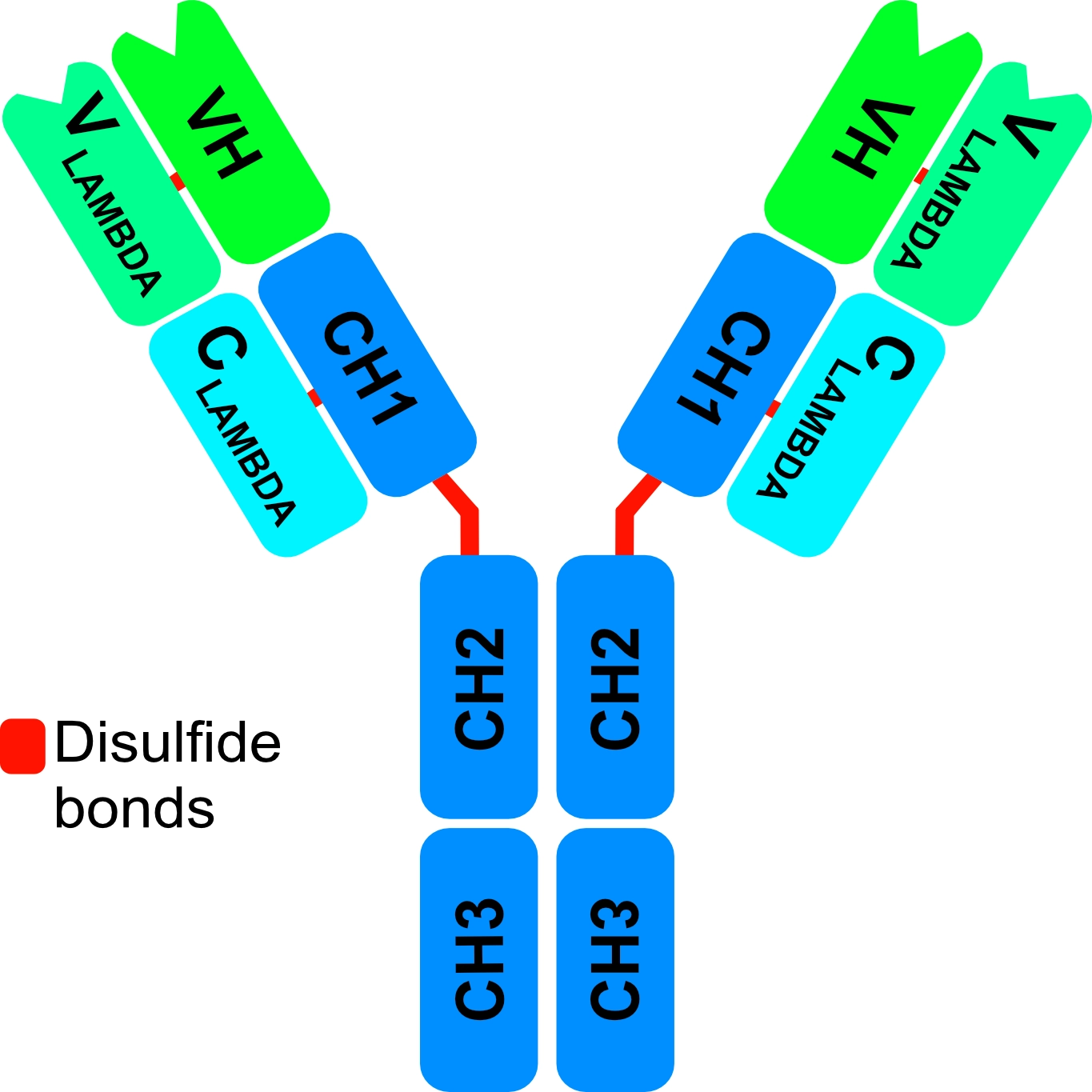
Figure 2. A simplified schematic representation of an Imaavy (nipocalimab-aahu). As an immunoglobulin G1 lambda (IgG1λ), the heavy chain consists of amino-terminal variable of heavy chains (VH) and multiple C domains (CH1, CH2 and CH3). The light chain consists of V- and C- lambda.
The active API Nipocalimab has an approximate molecular weight of 142 kilodaltons (kDa) and formulated with excipients consisting of arginine hydrochloride (25.35 mg), histidine (0.77 mg), L-histidine monohydrochloride monohydrate (1.07 mg), methionine (1.0 mg), polysorbate 80 (0.60 mg), sucrose (64.3 mg), and water as the final drug Imaavy.
Administration and Dosage Recommendations
Imaavy is supplied as a sterile, preservative-free solution for intravenous use after dilution. It must be diluted with 0.9% sodium chloride injection prior to administration; the total volume depends on the patient’s weight. The drug must be administered via intravenous infusion only.
The recommended dosage regimen is based on weight:
- Initial Dose: 30 mg/kg once via intravenous infusion over at least 30 minutes.
- Maintenance Dose: Two weeks after the initial dose, administer a maintenance dosage of 15 mg/kg via intravenous infusion over at least 15 minutes. Continue this every two weeks thereafter.
Alternatives and Competition
Historically, treatment has relied on immunosuppressive therapies as the standard. Most of which broadly suppress the immune system, these include:
- Corticosteroids: High-dose prednisone is often first-line and has high initial effects. But the initial effect diminishes over time due to severe cumulative toxicity (e.g., osteoporosis, metabolic syndrome). Only about 30% of patients maintain remission after 12 months due to cumulative side effects (e.g., bone health, metabolic issues).
- Imaavy offers steroid-sparing potential, allowing patients to taper corticosteroids while maintaining hemoglobin stability.
- Rituximab: An anti-CD20 monoclonal antibody used off-label for wAIHA, showing high initial response rates (~70–90%) but often followed by relapse within 12 months and risks of infection due to broad B-cell depletion.
- Immunosuppressants: Agents such as mycophenolate mofetil (MMF), azathioprine, and cyclophosphamide have varying degrees of success.
- Splenectomy: Effective for ~80% of patients but carries significant risks (infection, thrombosis) in addition to risks involved with surgery.
- On the other hand, Imaavy is a non-surgical alternative for suitable candidates.
Imaavy represents a shift from traditional broad immunosuppression to targeted antibody clearance. While standard therapies suppress the immune system broadly (risking infection and other side effects), Imaavy specifically targets pathogenic IgG levels, potentially sparing critical immune functions. Other recent alternatives to Imaavy are currently under investigation,9 including:
- Fostamatinib (SYK inhibitor): Showed promising results in wAIHA phase 2 studies but failed to meet the primary endpoint in phase 3 trials compared to placebo.
- Bortezomib/Daratumumab: Plasma cell-targeting agents used for refractory cases, often showing efficacy in multi-refractory post-transplant patients.
- Complement Inhibitors (e.g., Sutimlimab): Highly effective for cold agglutinin disease but less so for wAIHA; however, complement inhibitors are being explored for wAIHA with complement activation.
Conclusion
Imaavy provides a novel mechanism of action by reducing circulating pathogenic IgG through FcRn blockade. Clinical data from the ENERGY trial demonstrate its efficacy in achieving durable hemoglobin response and improving fatigue, with a safety profile comparable to placebo. It presents an alternative to traditional immunosuppressive therapies, offering potential for steroid-sparing and reduced relapse rates compared to rituximab, particularly for patients who do not respond adequately or experience significant toxicity from conventional treatments.
References
- FDA Approves First Drug for Warm Autoimmune Hemolytic Anemia. U.S. Food and Drug Administration: FDA News Release, 2026.
- Rarediseases.org. Warm Autoimmune Hemolytic Anemia. Available at https://rarediseases.org/rare-diseases/warm-autoimmune-hemolytic-anemia/ (accessed October 2, 2026).
- Cavallaro, F.; Barcellini, W.; Fattizzo, B. Antibody based therapeutics for autoimmune hemolytic anemia. Expert Opinion on Biological Therapy2023, 23 (12), 1227–1237.
- Vidarsson, G.; Dekkers, G.; Rispens, T. IgG subclasses and allotypes: from structure to effector functions. Front Immunol2014, 5, 520.
- Seth, N. P.; Xu, R.; DuPrie, M.; Choudhury, A.; Sihapong, S.; Tyler, S.; Meador, J.; Avery, W.; Cochran, E.; Daly, T.; et al. Nipocalimab, an immunoselective FcRn blocker that lowers IgG and has unique molecular properties. mAbs2025, 17 (1), 2461191.
- FDA approves IMAAVY® (nipocalimab-aahu) as first-ever treatment for warm autoimmune hemolytic anemia (wAIHA), representing a landmark advancement for patients. Johnson & Johnson: Press releases, 2026.
- Fattizzo, B.; Murakhovskaya, I.; Ueda, Y.; Schlichting, D.; Sweet, K. M.; Zelasky, M.; Craig, J.; Liva, S. G.; Leu, J. H.; Ling, L. E.; et al. Nipocalimab for warm autoimmune hemolytic anemia: results from the phase 2/3 randomized, double-blind ENERGY study. Blood2026.
- Imaavy (nipocalimab-aahu). Prescribing information. Johnson & Johnson, 2026. Accessed October 2, 2026. https://www.jnjlabels.com/package-insert/product-monograph/prescribing-information/IMAAVY-pi.pdf.
- Fattizzo, B.; Barcellini, W. New Therapies for the Treatment of Warm Autoimmune Hemolytic Anemia. Transfusion Medicine Reviews2022, 36 (4), 175–180.